Level9 · Working paper · The decision level By Eric Hathaway · September 2026 · Sources named in the text

We've done itbackwards

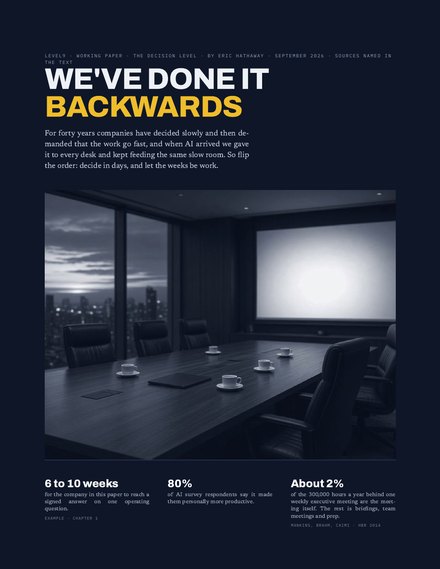
For forty years companies have decided slowly and then demanded that the work go fast, and when AI arrived we gave it to every desk and kept feeding the same slow room. So flip the order: decide in days, and let the weeks be work.

An empty executive boardroom at dusk. Chairs pulled back, coffee cups left on the table, a blank screen.
File EW-01 · Do we combine East and West?
Week 9 · Status: unsigned Signed
6 to 10 weeks

for the company in this paper to reach a signed answer on one operating question.

Example · Chapter 1
80%

of AI survey respondents say it made them personally more productive.

6%

work at a company earning 5% or more of its EBIT from AI.

McKinsey, State of AI 2026 · 1,719 respondents
About 2%

of the 300,000 hours a year behind one weekly executive meeting are the meeting itself. The rest is briefings, team meetings and prep.

Mankins, Brahm, Caimi · HBR 2014
Listen · 11 min

An eleven-minute audio companion, with the East-West meeting acted out.

0:00 / 11:14

Short on time? Hear the one-minute trailer. · Read it later: the PDF · the 13-slide deck

The short version

Five points, one per chapter. It's about half an hour to read, or eleven minutes for the audio companion, and if you only read this page, look at the decision file in Exhibit 04 next.

One caveat before the numbers. No named company has run this and reported a result. What the market has measured is that people and teams with the information up front work faster; the executive table is the part nobody has tried. East-West is a made-up company, and our math is a floor built on public pay rates.

  1. Same question, two calendars.

    An 800-person company spends six to ten weeks of slides on one question and still nobody signs. In the other order, the engine runs the rooms in a day, every executive reads their own page, and the answer gets signed at the first meeting, or the second at most.

    10 → 2weeks to a signed answer · example
  2. Every executive walks in knowing the room.

    The engine builds the rooms the question needs, runs three rounds in each and forces dissent when a room agrees too fast. Two weeks end to end: a week for the seats to file what only they have, a day for the engine to run the rooms, then one meeting. A day after the seats file, every executive and board member has their own page: what was decided, what to look at, how everyone else voted and every risk. The meeting argues about facts, not the deck.

    1 dayengine run, from filed inputs to a page for every executive
  3. It already works at the desk. The table never tried it.

    Controlled studies show people who get the information up front finish work 25 to 40 percent faster, and one person with AI can match a two-person team. Yet only one executive in six uses AI for strategic decisions.

    40%less time on writing tasks · Science 2023
  4. What it costs, and what you get back.

    Counted line by line, one decision drops from about 250 hours of people's time to about 34, which on a normal calendar means around 40 signed decisions a year instead of 12, and three times as much signed work for the teams.

    250 → 34hours per decision · our math
  5. Start with one question.

    Pick a question that's already on a calendar, write it down, pick the rooms, run it through the engine, and walk into the first meeting knowing the room.

    5 to 10questions a year worth doing this for
MarketA named study or survey. Our mathOur arithmetic on public pay rates. A floor, not a promise. ExampleA made-up company that shows the shape.
Chapter01

Same question. Ten weeks, or two.

A company of about 800 people runs two customer support offices, East and West. West wait times are the problem, and the COO wants to know whether to combine them. This is how that goes today, and how it goes when you flip the order.

It starts small. The CEO, the COO and the CFO agree the executive team should hear it, so a meeting goes on the calendar a week out. Two people turn out to be traveling. Staff starts building slides, and nobody has the full picture, so week one isn't a decision. It's a hunt for numbers.

Then the rest of the company gets pulled in, and teams start meeting to get ready for meetings. The team presents. Nobody signs. Someone suggests two more weeks for comments.

At the third meeting they vote while the two who missed the first ones are still reading last week's deck. Legal and HR were never in the room, so they hear about it afterward, and everyone meets again.

Six to ten weeks in, the teams are guessing at their jobs from a decision they only half heard. The fourteen people whose roles change still don't know what happens to them. West wait times haven't moved. The customer who was already waiting too long didn't stay for the third meeting.

3executive meetings before anyone votes, with two chairs empty in each one.
0of those meetings had Legal or HR in the room before the vote.
Example

A made-up company, built from meetings every operator has sat in.
Exhibit 01

Same week, two desks. Neither one has what the other has.

Example
An executive stands alone at the window of an empty conference room.
Upstairs · the COO

You asked for a decision. You got a presentation.

You've asked for a decision three times and gotten a presentation each time: two empty chairs, ninety minutes, twenty slides and no Legal or HR in the room. You have the cost target, but no answer you can hand the teams.

A support manager with a headset works late on slides at a laptop.
Downstairs · the West office lead

It's Sunday night. You're on slide version seven.

Your team met twice so your boss wouldn't be surprised. You have the wait times and the fourteen people, but not the cost target, and nobody has asked you for the one thing only you know.

The facts that decide this call sit on two different floors, and the process spends ten weeks making sure they never land on the same page.

Now run it in the other order.

On Monday the COO asks the same question as one sentence someone can sign: do we combine East and West support into one organization? The CEO doesn't book a meeting. The CEO says push it through the engine and see how the executive team, the board and the innovation team respond.

This is the part people get wrong. The engine doesn't hand down a signed answer that everyone nods along to. It does the prep that used to take ten weeks, before anyone walks into the room. A day later every executive and every board member has their own page, and the first meeting is about the real disagreements instead of who read the deck. The weeks that used to go to the vote now go to the work.

2weeks to a signature in the other order: a day for the engine, then one meeting, two at the most.
Exhibit 02

Same question, two calendars. The old way spends ten weeks getting to a vote.

Example
The way it usually goesSix to ten weeks of slides
W1W2W3W4W5W6W7W8W9W10
CEO · COO · CFOMtgWaiting on decks
Executive team2 outAgainVote
TeamsSlides, practice, status · 120 hours
LegalAfter
HRAfter
The officesMtgGuess

Week 10: a half-heard decision and a catch-up meeting, with West wait times sitting exactly where they started.

Same company, document firstA week of filing, a day for the engine, then one meeting
W1W2W3W4W5W6W7W8W9W10
CEO · COO · CFOCash
Executive teamSign
TeamsDataThe work · named owners, bound to the page
LegalRisk
HRRiskTalk to the fourteen
The officesWaitsCombine, or don't. Either way, moving.

Week 1: finance files cash, teams file their own data, Legal and HR file risk and the offices file wait times. Week 2: the executive team reads the file and signs, and from there it's work with a named owner on every job.

Scroll sideways to see all ten weeks. This shows the shape of the work, not a stopwatch on a real firm. Black blocks are meetings, yellow is prep, and blue is the file, the signature and the work after it.

Chapter02

Every executive walks in knowing the room.

Amazon swapped slides for written memos back in 2004, so writing it down first isn't new. What's new is that AI can now do the gathering and the arguing, so every executive gets their own page before the meeting and walks in already knowing the room.

Start with a sentence someone can sign.

"Support strategy" is a topic, and topics make decks. "Do we combine East and West support?" is a question someone can put their name under, and it tells you who needs to weigh in and what a finished answer looks like.

The engine then builds the rooms the question needs, in the order it needs them. For East-West that's the executive team, the board and an innovation team. Each room seats up to ten members, and each one brings its own data, its own limits and its own vote.

Exhibit 03

One question, nine steps.

Example
Write it

One sentence a person can sign, like "Do we combine East and West support?"

Owner
Round one

Each seat files the facts only it has, its limits and what would change its mind.

All seats
Check-in

The facilitators map where the seats clash and lay out the options.

Facilitators
Round two

Each seat votes on the options and names its conditions.

All seats
Check-in

The facilitators rework the leading option around those conditions and pull in any missing facts.

Facilitators
Round three

The final vote: for, against, or for with an exception on the record.

All seats
The file

One shared file, plus a page for every executive: the answer, the proof, the losing side and who does what.

Facilitators write it
Sign

One person signs or sends it back, pointing to the page.

One owner
Work

Named owners get to work, and nobody reopens the debate.

The teams
Finance

Fights for cash: what the move costs and when it pays back.

Operations

Fights for what breaks, starting with what happens when one office becomes the only office.

East and West leads

Bring what only they know: the real wait times, the queue and the fourteen people whose jobs change.

Legal

Checks the notices, leases and contracts that move with the office.

HR

Owns the people plan: who changes jobs and who hears it first.

Strategy

Holds the written question so the group doesn't wander off into a different company.

Scroll sideways to see all nine steps. Circles are rounds. Diamonds are check-ins run by the facilitators, who take no side. This is one room; bigger questions run the same steps in more rooms. You pick who fills each seat: the actual owner, or whoever knows that job best.

Three rounds, each with one job.

The rounds aren't more talking. The first gets the facts only one seat has onto the table, the second is a vote where every seat names its conditions, and the third is the final vote on the reworked answer. Research on groups points the same way. How a group closes a decision matters more than how long it argues, and structured voting beats open-ended consensus-seeking (Kaesberg et al., ACL 2025), and AI models drift toward whatever the person asking already believes (Sharma et al., ICLR 2024), so each round is short and has a single job. And when drift detection sees a room agreeing too fast with no new facts, the engine makes at least two seats argue the other side before the final vote.

Real seats, not one voice in ten hats.

A finance seat isn't a chatbot told to act like the CFO. Ask one model the same question ten ways and the answers drift toward agreement, usually with made-up support sitting right next to them, because agreeing is the easy path.

A real seat brings its own data, the limits of its job and a record of what it argued last time, so finance fights for cash while operations fights for what breaks when one office becomes the only office. Each seat pulls from the company's own numbers, fresh market research, the risks and what the team can actually carry. If they all sound like the same reasonable person by lunch, you don't have a debate. You have a press release.

What the research showsAI models that debate each other tend to talk themselves into the same wrong answer, and accuracy can drop the longer they talk. Yao et al. 2025 · Wynn, Satija and Hadfield 2025 · preprints

Multi-model, with drift detection.

The engine is multi-model, and every seat gets its input from its own independent agent, so one model's blind spots don't become the whole room's. Drift detection watches every room for the slide toward easy agreement: unanimous votes, confidence bunching together, dissent going quiet. When it sees that, the engine forces the argument back onto the table.

Fourteen facilitators, and none of them votes.

Between rounds, fourteen facilitators check the work: whether the room brought up facts only one seat had or just repeated the shared slides, whether anyone changed a vote without a reason, and whether every claim traces back to where it came from. Then they write it all down: the options, who pushed back on what, the vote by seat and what's still missing.

A facilitator can't carry its own version of the story, or you've just built a second decision-maker. The record is locked, and every step, vote and source is open to every member of the team, so nobody can quietly steer it.

Six rules that keep the group from turning into one polite voice
  • R1If everyone agrees too fast with no new facts, start over.
  • R2A seat can change its vote only by pointing to new facts.
  • R3Any claim without a source in that seat's own files gets cut.
  • R4The losing side stays on the page, in its own words.
  • R5If the winner was just the path with the fewest fights, say so, so the signer picks it on purpose.
  • R6Every executive gets their own page before the meeting, and any "no" has to point at something on it.

Every executive gets their own page.

A day after the question goes in, every executive and every board member has their own page. Take the CMO. It shows what the rooms decided, the facts the CMO should be looking at, how every other seat voted and why, and every risk on the table, with everyone else's answers one click away. Now the CMO can agree or disagree with all of it.

A day later, on every desk

This is what everyone has before meeting one.

Example
  1. What the rooms decidedOne answer, in one sentence, with the conditions attached.
  2. The facts you should look atPulled for your seat, with the source on every claim.
  3. How everyone else voted, and whyIncluding the seats that voted against you.
  4. Every risk on the tableWhat breaks, who owns it, and what would reopen the decision.
  5. What to ask in the roomThe questions only you can settle, ready before you walk in.

A day after the COO's question went in, every executive had their own page. Here are three of them, for the same decision. Same facts, three different jobs to do in the room. Each one opens with a short recording for the drive in.

1 dayfrom the question going in to every executive holding their own page.
The CEO's 85 seconds, the morning of meeting oneRead by an AI voice · press play above

    Level9EW-01 · The CEO's page Ready a day after the question went in · ELT meeting Thursday
    For the CEO · read before Thursday

    Two no votes, and both are about how you do it. Nobody's against doing it.

    Your COO is asking the ELT to sign one question: do we combine East and West support into one organization? West callers wait almost three times longer than East, and hiring hasn't fixed it.

    What the room recommends

    Combine into one support organization, keep both offices open through the switch, and don't cut over until a failover test has passed.

    How the six seats voted

    2 for · 1 no block · 1 conditional · 2 against

    Saved a year

    $640k

    Cost to do it

    $395k

    Pays back

    ~7 mo

    If nothing slips

    Jobs that change

    14

    All on the West side

    Who's at the table
    Round 3 of 3 · 6 seats voted
    COO

    Brought the question · signs

    Signs

    "I want this signed Thursday or sent back with a page number."

    Keep the room on the one question. Every side topic pushes the signature to another meeting.

    CFO

    Finance seat

    For

    "It pays back in about seven months if we're out of the West lease in year one."

    Already in. Watch that the seven months doesn't get sold as a sure thing.

    VP Operations

    Operations seat

    Against

    "One queue fails as one queue, and we've never tested a failover."

    They lost the vote and won the condition. No test date yet.

    CHRO

    HR seat

    Against as sequenced

    "Fourteen people hear it from us before any announcement, or I'm a no."

    Costs about two weeks, and it's the easiest yes all meeting.

    The rest of the page

    Four more seats, the numbers that have to be in the room, the payback math and the three questions only the CEO should ask, plus the notes to send before anyone sits down.

    See the CEO's whole page

    Example. East-West is the made-up company from this paper, and the pages follow decision file EW-01 in Exhibit 04. The dollar figures, hold times and budget splits are illustrative. The recordings use AI voices.

    Nobody says "I don't agree with the AI."

    The pushback gets specific instead. "I'm a no for now. Section 5, Exhibit A. The customer data is 8 percent off what we're seeing, and that changes the numbers. My team is checking how much it matters, and I'll have it to you tomorrow." Legal's two requirements were already on the page, with the board room's answer: on this timeline, with these blockers, if you all agree, move.

    Behind those pages sits one shared file, and it is the thing that gets signed. This is the East-West file on the morning the COO signs it.

    Exhibit 04

    The file the room signs. Not a deck.

    Example
    Decision file EW-01Ready to signRound 3 of 3 · 6 seats
    The question

    Do we combine East and West support into one organization?

    Recommended answer

    Combine into one support organization across both sites while keeping both locations open through the transition, and gate the cutover on a tested failover.

    The losing side, in its own words

    We're signing a single point of failure for a customer who already waits too long. Show us failover working before the cutover date, not after.Operations seat · kept on the page per R4

    Who does the work
    • Operations: failover test, as the cutover gate
    • HR: role conversations with all fourteen, first
    • Finance: lease exit plan
    • East lead: cross-training schedule
    Reopen facts
    • The failover test fails
    • West wait times rise during cutover
    • The lease exit slips past year one
    Stripped claims

    "Customers won't notice the change." was removed under R3, because no seat's file had a source for it.

    SignSend back

    COO · owns the outcome · if "send back," cite the page

    A made-up example, not a real firm. The pages above show how each seat voted; this is the record they all point at, including the claims that got cut and the conditions the plan now has to meet.

    Operations lost the vote and won the gate.

    Look at what happened to the losing side. Operations voted against, and its condition, a tested failover before cutover, became the gate the whole plan has to pass. That's the difference between losing an argument and being ignored, because the concern lives in the file with an owner, and if the failover test fails, the decision reopens on its own.

    Meeting one. Meeting two at the most.

    Everyone walks in already knowing the room, so the argument is about 8 percent, not about who read the deck. Six to ten weeks becomes two, and the staff hours on the decision drop by about 86 percent. In less than a day, for less than one executive meeting costs, any question can run through it. After the signature, any meeting that isn't doing the work or dealing with a reopen fact, one of the named facts that would force a fresh look, is a leak.

    Build the rooms you don't have.

    If you don't have an innovation team or an investor forum, build one. Copy your executive team, add the roles you don't have yet, or build a board to test the call against. As the CEO you get to hold that board to account, and you walk in knowing three quarters of the room, often with half of it handled before you sit down. The same file moves from room to room without anyone rewriting it for the next audience.

    Chapter03

    It already works at the desk. The table never tried it.

    None of this needs a leap of faith. The market has already measured what happens when people get the information up front: they work faster, and one person with AI can do what used to take two. The one place nobody has tried it is the table where the decisions get made.

    Give someone what they need up front instead of making them hunt for it, and they get faster. That isn't our claim. It's what controlled studies found when they split people into groups with and without AI and measured the actual work.

    Exhibit 05

    When people get the information up front, measured work gets faster.

    Market
    People working on their own, with AI against without
    Less time on professional writing tasksNoy and Zhang, Science 2023 · 453 professionals
    40
    Faster on realistic consulting tasksDell'Acqua et al., BCG study · 758 consultants
    25
    More support issues solved per hour, newest agentsBrynjolfsson, Li, Raymond, QJE 2025 · 5,179 agents
    34
    More support issues solved per hour, all agentsSame study
    14
    0255075100
    Teams

    At Procter & Gamble, one person with AI matched a two-person team without it, and AI pulled R&D and commercial people out of their usual silos. Dell'Acqua et al., Organization Science 2026 · 776 professionals.

    Each bar is the measured gain, in percent, for the group using AI against the group without it, in that study's own terms. The BCG study also found a limit worth knowing: on a task outside what AI does well, consultants using it got the right answer less often, which is why a person still signs.

    The people who asked for it haven't used it.

    Leaders spent two years asking every team to adopt AI, and three in four knowledge workers now use it at work. Yet only about one executive in six uses it in strategic decisions, according to Capgemini's 2026 survey of 500 of them. The table that demanded it is the one table still running on slides.

    That's why the gains don't show up in earnings. Eighty percent of the people McKinsey surveyed say AI made them personally more productive, but only 6 percent work at companies earning 5 percent or more of their profit from it. The speed is real, it just runs into a room that still decides the old way.

    1 in 6executives use AI in strategic decisions, against 3 in 4 knowledge workers using it at work. Capgemini 2026 · Microsoft Work Trend Index 2024
    Exhibit 06

    People say AI made them faster. Very few companies can find it in their earnings.

    Market
    Question 1 · Did AI improve your own productivity?
    Respondents who say yesSelf-reported, about their own work
    80
    Question 2 · Did AI show up in your company's earnings?
    Respondents whose company saw any EBIT impact from AIAny amount at all
    37
    Respondents at AI high performers5% or more of EBIT from AI, plus significant value
    6
    0255075100

    These aren't a funnel. All three bars come from the same 1,719 people in McKinsey's State of AI 2026, but they answer two different questions, one about their own work and one about their company's earnings.

    The room was slow before AI showed up.

    This isn't new. Bain found in 2006 that only about 15 percent of the 365 companies it studied made and carried out decisions well. In 2014, Mankins, Brahm and Caimi traced everything one weekly executive meeting at one large company set in motion over a year. It added up to 300,000 hours of people's time, and the meeting itself was 7,000 of them.

    Exhibit 07

    Of 300,000 hours a year behind one weekly executive meeting, 7,000 are the meeting.

    Market
    The weekly executive meeting itself7,000
    11 unit-head briefing meetings20,000
    21 team meetings63,000
    130 prep meetings210,000

    Slide work isn't even counted. If the whole pile were 100 hours, the meeting itself would get about two.

    Each square is 1,000 hours of people's time in one year. Mankins, Brahm and Caimi, Harvard Business Review, 2014. The study is old, but the way that pile gets built hasn't changed.

    In the other order

    The same AI that already makes each person faster runs the rooms before the meeting, so every executive starts from their own page instead of a blank one.

    Chapter04

    What it costs, and what you get back.

    The cost side of this chapter comes from market data, and the savings side is our own math on those same numbers at public pay rates, a floor rather than a promise. At the end of the chapter you can put your own company in and run the same math on your numbers.

    An empty boardroom at dusk, the projector screen still lit, coffee cups left on the table.
    The room the hours are spent in. Lit screen, full cups, no signature.

    You're already paying for it.

    The meeting isn't the hour on the calendar. The heaviest calendars get interrupted every two minutes during core hours, and PowerPoint edits jump 122 percent in the last ten minutes before a meeting (Microsoft, 2025). The managers staging all of it are down to 22 percent engaged worldwide (Gallup, 2026). Meanwhile 81 percent of organizations in McKinsey's 2026 survey of more than 10,000 executives report no real bottom-line gain from AI.

    Where the 250 hours come from.

    Counted out for East-West, meeting by meeting, the old way looks like this, and it's deliberately on the low side.

    Every 2 minthe heaviest calendars get interrupted during core hours. Microsoft 365 data · 2025
    Exhibit 08

    250 hours the old way, 34 in the file, counted line by line.

    Our math
    Where the time goes on one East-West decisionHours
    The old way
    Three executive meetings, 8 people, 90 minutes each36
    Pre-reads and side conversations, 8 executives24
    Slides and prep meetings, 4 teams of 3 people, 10 hours each120
    Catch-up meetings after the vote, 10 people, two rounds30
    Rework once Legal and HR weigh in, 4 people40
    Total, the old way250
    In the file
    Seat owners check their data and the run, 6 people, 2 hours each12
    Writing the question so one person can sign it1
    First run only: building the rooms and the seats3
    Spot-checking the engine's sources, 2 people, 1 hour each2
    Allowance for one send-back and a second pass3
    A person reviews the file before it goes out3
    Eight executives read their own page, 30 minutes each4
    One 45-minute signing meeting, 8 people6
    Total, in the file34

    Checked against the market. Mankins' study found about 40 hours of prep for every hour in that executive meeting. This count uses fewer than 6 to 1, so the real old-way number is likely higher. The engine side now carries its own overhead too: writing the question, the first-run setup, checking sources and an allowance for one send-back.

    Now yours

    What one decision costs you now.

    East-West gives back 216 hours on one decision, and the count above is ours, not yours. Pick your company size and see your own: pay comes straight from Bureau of Labor Statistics data, and every line of the math is one click away inside the calculator.

    The argument survives a worse count.

    Even if the old way took only 100 hours and the file took 50, the file would still cut the time in half and turn ten weeks into two. The case does not rest on the exact hours. It rests on the order.

    $23,750 the old way. $3,230 in the file.

    Put public pay rates on those hours. Bureau of Labor Statistics data puts an operations manager at about $75 an hour with benefits and a financial manager at about $119, so we use $95 for the East-West seats, rounded down from the $97 midpoint to keep every figure a floor. Equity and bonuses aren't in it, which is why real numbers sit above ours.

    Exhibit 09

    One decision: $23,750 the old way, $3,230 in the file.

    Our math
    One East-West decision, people's time priced at $95 an hour
    The old wayCounted line by line in Exhibit 08
    250 hrs · $23,750
    Document firstThree rounds, one read, one meeting
    34 hrs · $3,230
    $49Loaded hour across all civilian jobs, for scale only. BLS ECEC, all civilian workers, March 2026
    $75Operations manager, loaded. $105,770 median wage, BLS OEWS May 2025, × 1.481
    $119Financial manager, loaded. $166,570 median wage, BLS OEWS May 2025, × 1.481
    $95Blend used for East-West seats. The midpoint of $75 and $119 is $97; we round down to $95 so the figure stays a floor

    A second check. Saving eight people five 45-minute meetings a week for 48 weeks comes to 1,440 hours, about $137k at the same rate. That's not a trial or a real company's result.

    40 signed decisions a year instead of 12.

    One decision is nice, but a year of them is the point. With the executive team signing twice a month and the board four times a quarter, the same calendar holds about 40 signed decisions instead of the 12 the old way manages in a good year. Twelve decisions at 250 hours is about 3,000 hours. Forty at 34 is about 1,360, under half of it.

    But the point isn't the hours you save, it's what they open up. The teams that spent weeks building slides now have three times as many signed decisions to work on, so the whole pipe finally runs. That's the premise this paper started with. Take the blocker out of the room at the top, and all the AI speed already sitting at the desk finally has somewhere to go, and it starts to build on itself across the company.

    Exhibit 10

    Same calendar: 40 signed decisions a year against 12.

    Our math
    A company that decides document firstExec team signs 2 a month · board signs 4 a quarter
    40
    A company still running six-to-ten-week pilesExec team finishes 8 at best · board gets 1 real call per packet
    12
    Exec team decisions, 24 Board decisions, 16 Exec team decisions, 8 Board decisions, 4

    Each dot is one signed decision. It's an example year built from the counts in Exhibit 08, not a trial. Plenty of companies never reach eight finished decisions a year, because they get the slide pile instead.

    At enterprise size the pile around one weekly executive meeting costs about $22.5 million a year at the same rates, which is 300,000 hours at $75. That's the size of the bill, not the savings, but even a four-week slice of it is $1.7 million.

    Nearly half the lost value is gone before the work starts.

    Deciding faster matters most at the front. McKinsey's survey of 1,034 people who'd been through a big company change found that nearly half the value that gets lost disappears while the company is still arguing about the target, before any work begins.

    Exhibit 11

    Nearly half the lost value is gone before the work starts.

    Market
    Where the value lost in a big company change goes missing, as a share of all value lost
    Lost before the work starts · 45%
    Lost during and after the work · 55%
    Changes people called successful
    67%of the maximum financial benefit was captured
    Every other change
    37%of the potential benefit was captured

    McKinsey's 2021 survey of 1,034 people who'd been through a big company change reports that 55 percent of the lost value goes missing during and after the work, 20 percent of it after. The 45 and 35 percent pieces follow from those figures. Every number here is a share of the value that gets lost, not of total value.

    Exhibit 12

    What the CEO gets back, on one decision and across a year.

    Our math
    What movesThe old wayIn the fileWhat comes back
    One decision
    Weeks to a signature1028 weeks
    Executive meetings before anyone signs312 meetings
    Staff hours on the decision25034216 hours
    Cost of the decision, at $95 an hour$23,750$3,230$20,520
    Your own hours in it7.51.256.25 hours
    A year of them
    Decisions that actually get signed124028 more
    Staff hours spent deciding3,0001,3601,640 hours
    Your own hours in decision meetings905040 hours
    Signed work the teams can start on12403.3×

    Every line comes out of Exhibit 08. Your own hours are the executive lines of that count: three meetings at ninety minutes plus an hour of pre-read each, against reading one page and sitting one forty-five-minute signing meeting. The year assumes twelve signed decisions the old way and forty in the file. This is arithmetic on a made-up company at public pay rates, not a result any firm has reported. The honest headline is the one the paper opened with: you spend forty fewer hours a year on deciding and sign twenty-eight more decisions.

    Lose in public, not in the meeting.

    Today the miss is inside the building: nobody owned the answer, the wait times stayed where they were and a customer left while everyone was still in slides. Decide first and whatever miss is left belongs to the market, where you combined the offices and service still slipped, or the customer just said no. That company lost in public and can learn from it, while the other one never decided at all.

    Chapter05

    Where to start.

    Start small, on one question that matters. The size of the company changes where that question lives.

    Size changes where you start.

    At twenty people the founder is the room, the board and the only memory of why the last call went the way it did, so the file becomes the company's memory. At two hundred to two thousand, start with the executive team, where the pile is heaviest and the hours come back first. Past five thousand, don't try to flip the whole enterprise at once, flip the questions a unit or a region truly owns.

    5 to 10questions a year really matter that much. Use it there, not on office chair orders.
    Your first question

    Five steps. One question. Know the room.

    1. Pick one question that's already on a calendar.

      Choose one that would otherwise take three meetings to settle, not the snack vendor or anything you could decide in a hallway.

    2. Write it as one sentence a person can sign.

      "Do we combine East and West support?" works because someone can put their name under yes or no, and "support strategy" never allows that.

    3. Pick the rooms, and who's in them.

      Start with the executive team, then add the board, an innovation team or an investor forum if the question needs them, and build the ones you don't have. Put Legal and HR in from the start instead of briefing them after the vote.

    4. Run it through the engine.

      Three rounds in every room, dissent forced when a room agrees too fast, and fourteen facilitators checking every step. A day later every executive has their own page.

    5. Walk into meeting one knowing the room.

      Sign it or send it back, pointing at the page. Then count the hours you didn't spend, and hand the weeks you saved to the people who do the work.

    Before you run it

    What this paper claims, and what it doesn't.

    We don't have a named company that ran this and reported the result, and we're not pretending to. The claim is narrower: the market has already measured that people and teams with the information up front work faster, and the executive table is the one place that hasn't been tried. East-West is a made-up company, our math is a floor built on public pay rates, and Level9 sells software that runs this method, which is why every number here is labeled with where it came from.

    It isn't real.

    You pick who fills each seat, the actual owner or whoever knows that job best, so the room is built for the question, which is the opposite of a costume.

    People won't trust it.

    They shouldn't on faith. The page goes out before the meeting with everything visible, who filed what, what got cut and the option that lost, and trust comes from reading it early enough to push back.

    It costs too much.

    The first run costs less than scheduling the meeting you'd use to evaluate it, and if the page is wrong, you send it back and make the call yourself.

    It's more tech debt.

    You keep your tools and agents. The page sits above them, and after the signature they work from a signed answer instead of a hallway conversation.

    The paper, in four sentences

    Write the question.Let the teams argue.Sign the page.Let the weeks be work.

    AI is good at exactly what a decision needs: holding every fact, keeping the options that lost and remembering what finance argued last time. We had the engine, and we used it to write email.

    I've sat in both chairs. We assumed faster tools at the bottom of the company would fix the room at the top, and they didn't, so flip the order and give the table the same head start everyone else already has.

    About this paper

    Where Level9 fits.

    Everything in this paper works with people, a shared document and a calendar, and it's worth running your first one that way so you know what good looks like before any software touches it. Level9 builds StratOS to run this same method: rooms of up to ten seats that bring their own data, independent agents across multiple models, three rounds with drift detection and dissent forced, fourteen facilitators checking every step, and a page for every executive before the meeting.

    It works alongside the agents and tools you already have, so you can use as much or as little of it as you want. You can find it at level9os.com.

    Want to send this to someone, or mark it up? Download the PDF, a 13-page two-column edition with every source linked, and all three executive pages in the appendix. There is also a 13-slide deck and its PDF.

    Take it with you
    NotesHow to read the numbers, terms and sources

    How to read the numbers

    Market numbers come from a named study or survey, cited where they appear.

    Our math numbers are our own arithmetic: the hours from the line-by-line count in Exhibit 08, priced at Bureau of Labor Statistics pay rates with benefits (median wage × 1.481, the BLS ECEC ratio of total compensation to wages for management, business and financial occupations, divided by 2,080 hours a year). Treat them as a floor, not a return any real company has earned. Equity and bonuses aren't included.

    Example material, including the East-West company and its decision file, is made up from meetings every operator will recognize, and the photos are illustrations, not a real firm.

    Words this paper uses

    Seat
    A function at the table with its own data, limits and vote.
    Room
    A group of up to ten seats, like the executive team, the board or an innovation team.
    Facilitators
    The fourteen checks that run between rounds without a vote.
    Your page
    The one page each executive reads before the meeting.
    The file
    The one page the signer reads and signs.
    Reopen fact
    A named fact that forces a fresh look if it comes true.
    The pile
    The hours spent making a meeting look prepared.
    Press release
    A file where every seat agrees and nobody brought a new fact.

    Sources